
I Wanted to Be a Good Man — But I Kept Shutting Down
For decades, I poured every ounce of my energy into a single goal: being a good man. I wanted to be a reliable husband, a patient father, and a reliable leader. But every time stress, criticism, or conflict hit, my system crashed. I would emotionally shut down. Instead of connecting with the people I loved, I shifted into a cold, defensive state, treating them like problems to be solved.
In leadership, there is a concept known as the lid. It is a ceiling on your potential. No matter how hard you push, your ability to lead others is limited by your own emotional maturity. I realize that sheer willpower is insufficient. When the pressure spikes, a person cannot white-knuckle their way out of being irritable or defensive.
I Tried Harder. It Still Didn’t Work.
I thought the cure was stricter discipline. I woke up earlier to pray, spent more time reading, and held myself fiercely accountable. I assumed I could just try harder. This was my entire operating paradigm for years: reason plus good choices equals transformation.
I believed that if I just acquired the right information and made the correct decisions, my character would change. But the gap between the change I sought and the reality of my life kept growing. None of these disciplined methods produced lasting results, leaving me with a quiet, growing desperation.
Turns Out, It’s Not a Willpower Problem. It’s a Brain Problem.
I began to see that the problem wasn’t a lack of faith. I was attempting to drive change through a sense of threat — a constant pressure to perform that left no room for actual growth. What feels like leadership burnout is often a biological misdiagnosis.
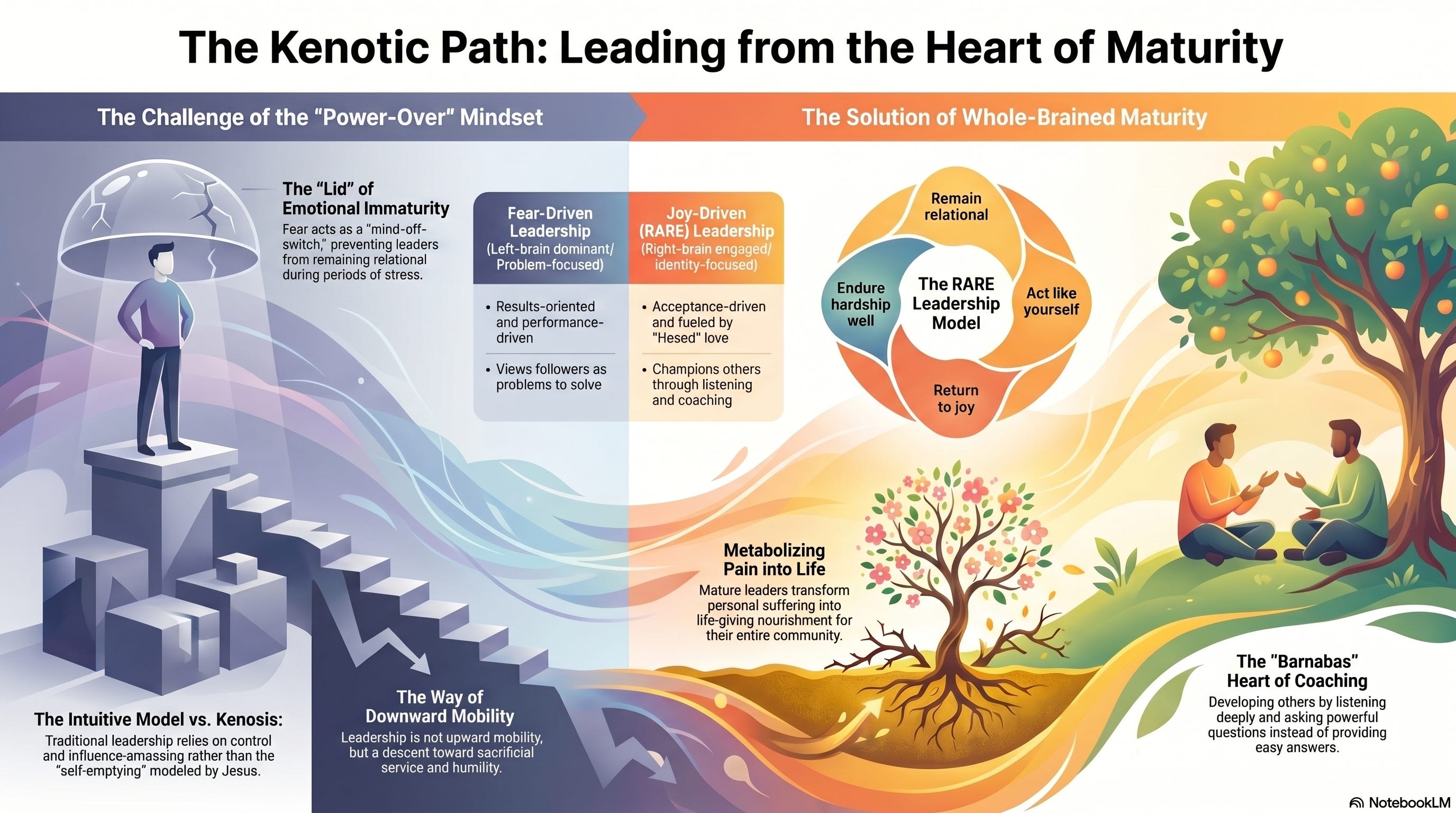
To actually transform, we have to look past our habits and understand the mechanics of the brain. The left hemisphere is our analytical center, fueled by logic and fear. During conflict, this system locks up, shutting down empathy and forcing a fight-or-flight response. To break the cycle, we engage the right hemisphere’s relational circuit — which runs on a different fuel: joy.
Neuroscientists define joy as a high-energy state where another person is genuinely happy to be with you. It functions as a specialized biological fuel for the brain. You cannot think your way to emotional maturity.
So What Actually Works? Meet the RARE Framework
To survive high-stakes stress without melting down, a leader has to actively engage the right-sided relational network. This brings us to a practical method for building that maturity, known as the RARE framework:
R — Remaining Relational
A — Acting Like Yourself
R — Returning to Joy
E — Enduring Hardship well
Here’s What It Looks Like to Process Pain Instead of Pass It On
This is the process of metabolizing pain. Just like your physical body digests food, an emotionally healthy leader processes difficulty. They take in the toxicity, shame, and conflict of their environment, digest it, and output life-giving nourishment back into their community.
Instead of deflecting stress onto their teams, the leader acts as a biological filter. They deliberately absorb the blow, stopping the cycle of trauma in its tracks.
The Moment That Put Everything to the Test
The theory of metabolizing pain was put to the test in my own life in 1994, when my mother was murdered by two teenagers. The shock was suffocating. The standard human response is to let the left brain take over — to lock into anger, demand vengeance, and treat the situation as a problem to be eradicated.
Years later, I stood in a courtroom looking at the two people who took her life. And in that moment, I made the choice to offer forgiveness. I didn’t excuse the crime, but by forgiving them, I took an agonizing trauma and processed it. I metabolized that violence and output grace.
God can enable an individual to metabolize that level of pain, it proves the power of this operating system. It means we have the capacity to overcome any everyday conflict in our homes or our organizations.
What If Leading Well Means Stepping Down, Not Climbing Up?
Most leadership models run on upward mobility — amassing influence and proving you are the smartest expert in the room. But there is an alternative model known as kenotic leadership. Kenosis means self-emptying.
We see this in the account of Jesus, who stepped away from a position of power to wash the dirt off his disciples’ feet out of pure, attachment love. To adopt this model, you have to relinquish the idol of being the fixer. You have to lay down the need to always have the right answers and control the outcome.
Sustainable influence does not come from climbing higher to command problems. It comes from stepping downward to connect with people.
This Is What I Practice Every Single Day
Today, my daily reality is a retraining of my own brain. I practice the art of slowing down, asking powerful questions, and listening as a coach rather than instantly giving advice. It also means stepping into the role of the flack-catcher — instead of getting defensive, an emotionally mature leader absorbs community frustration and repents on behalf of others to restore peace.
When leaders abandon fear and lead from a place of self-emptying joy, they move beyond basic survival. They transform hardships into a source of life for others.